I’m Shalini Patel, and I’ve completed over 20 Kailash Parikramas since 1996. Every year, I meet NRIs from the USA and Canada who tell me they’ve been putting off this pilgrimage for years because they think it’s too complicated from abroad. That’s the first thing I tell them is wrong.
The Kailash Mansarovar Yatra for NRIs isn’t harder than it is for someone living in India. It’s different, yes — but once you understand the actual process instead of what your cousin’s friend posted on Facebook, the path becomes remarkably clear. Especially in 2026, which is a Tibetan Horse Year. That happens once every 12 years, and the spiritual significance of completing your Parikrama during this window isn’t something I can overstate.
Here’s what really stops NRIs: they believe myths about documentation, they worry about fitness from a desk job in Seattle or Toronto, and they think they’ll manage the spiritual preparation on their own. I’ve watched those assumptions delay the journey for people who were actually ready. Let’s fix that right now.

Myth One: The Visa Process for NRIs Is a Bureaucratic Nightmare
This is what I hear most. “Shalini, I have a US passport now. Won’t Tibet reject my application?”
No. Won’t happen if you do it right.
The Chinese visa process for NRIs holding American or Canadian passports is straightforward when you work with an operator who has done this hundreds of times. You don’t apply on your own. You never should. The Tibet Travel Permit and Group Visa are issued through registered tour operators in Nepal or Tibet — individuals can’t get them independently anyway.
Here’s the actual process. You’ll need a passport valid for at least six months from your departure date. That’s non-negotiable. You’ll also need to plan at least three to four days in Kathmandu before the yatra begins. Why? Because Chinese immigration requires biometrics — fingerprints and a photo — and that happens in person at the Chinese Visa Application Centre in Kathmandu. You can’t skip this step, and you can’t do it from New York or Vancouver.
Kailash Pilgrim handles the entire permit coordination. We submit your documents, process the Group Visa through our Nepal office, and ensure your Tibet Travel Permit is ready before you even land. I’ve had clients tell me they expected weeks of back-and-forth emails. In reality, once you send us clean scans of your passport and photos, we handle the rest. The system works when you stop trying to figure it out solo.
One mistake I’ve seen repeatedly: NRIs assume they can use an India-based operator and fly into Delhi first. That complicates things. The Nepal route via Kathmandu is cleaner for foreign passport holders. All the permit processing, acclimatization, and onward travel to the Tibet border flows smoothly from Nepal. Don’t make it harder than it needs to be.
And yes, you’ll stay in Kathmandu for three to four days. That’s not wasted time — that’s your first altitude adjustment and permit clearance window. Use it.
Myth Two: You’re Too Old or Too Out of Shape for This Trek
I get emails from 50-year-olds in California who jog twice a week and think that’s not enough. I also get emails from 45-year-olds in Toronto who haven’t exercised in five years and assume they’ll wing it.
Both are wrong.
The Kailash Mansarovar trek from USA or Canada doesn’t demand Olympic fitness. It demands specific preparation — cardiovascular endurance, altitude tolerance, and mental stamina. If you’re physically capable of walking five to six hours a day at elevation and you commit to a structured prep program, age is irrelevant. I’ve guided 60-year-olds who completed the Parikrama with fewer issues than 35-year-olds who showed up unprepared.
Here’s what actually breaks people: they don’t train for altitude. They assume their gym cardio in Dallas or their weekend hikes in British Columbia translate to 15,000 feet and above. They don’t.
At Kailash Pilgrim, we run a one-year preparation program for every yatri. Not because you need 12 months to get fit — most people need four to six months of focused work. We start a year early because life gets in the way. Jobs. Kids. Holidays. If we tell someone in March 2025 to prepare for June 2026, they actually have the buffer to train consistently without panic.
The program covers cardiovascular conditioning, breath control exercises, and progressive stamina building. We also evaluate your gear — boots, clothing layers, trekking poles — because the wrong equipment at altitude isn’t just uncomfortable, it’s dangerous. I’ve seen blisters from new boots sideline someone halfway through Parikrama. That’s avoidable.
Here’s the part nobody talks about: mental stamina matters more than your VO2 max. The Parikrama is 52 kilometers over three days, crossing Dolma La Pass at 18,600 feet. Physically, that’s manageable for most prepared adults. Mentally, when you’re cold, tired, and altitude is messing with your sleep, that’s when people quit in their heads before their bodies give out.
Which is why we prepare you spiritually as much as physically. This isn’t a trek. It’s a pilgrimage. Your body will follow if your intention is clear.
One more thing. If you have a pre-existing condition — hypertension, asthma, heart concerns — you must disclose it early and get medical clearance. I won’t take someone whose doctor hasn’t signed off. Our 28-year safety record isn’t luck. It’s discipline.
Myth Three: All Kailash Yatra Packages Are Basically the Same
This is where NRIs get burned.
You’re in Chicago or Vancouver, searching online for “Mount Kailash tour packages NRIs,” and you see prices ranging from USD 2,650 to USD 5,000. You assume the difference is markup. It’s not. The difference is what happens when things go wrong.
The baseline cost for the Kailash Mansarovar Yatra for NRIs in 2026 is around USD 2,650 to USD 2,900 per person. That typically includes Tibet permits, accommodation, vegetarian meals, and ground transport from Kathmandu to Mount Kailash and back. Some operators quote USD 3,900 if the itinerary includes Lhasa. That’s standard.
But here’s what separates a safe, spiritually fulfilling yatra from a logistical disaster: who’s actually leading the journey, what the group size is, what the food quality is, and whether there’s real on-ground support when altitude sickness hits at 2 a.m.
Kailash Pilgrim operates in small private batches. Not 40-person bus groups. We cap our yatra groups because I’ve learned over 28 years that personalized attention isn’t a luxury at 15,000 feet — it’s a safety requirement. When someone in a large group struggles with altitude, the guide has to choose: delay everyone or push the person beyond their limit. In a small batch, we adjust. We support. We make sure no one is left managing a crisis alone.
We also serve 100% Sattvic meals throughout the yatra. That’s vegetarian, fresh, prepared according to traditional guidelines that support spiritual practice and physical endurance. I’ve watched other groups serve reheated, low-quality food that leaves yatris weak and nauseous at altitude. Your body is already fighting thin air and temperature swings. Bad food makes everything worse.
Then there’s the preparation. Most operators hand you a packing list and a good luck message. We run a structured year-long program — fitness guidance, spiritual readiness calls, gear evaluation, and real answers to your questions. By the time you land in Kathmandu, you’re not a nervous first-timer. You’re ready.
Finally, experience. I’ve done this 20 times. I know which campsites handle weather better. I know when to push and when to rest. I know what early signs of altitude sickness look like, and I know how to manage them before they escalate. That’s not something you get from an operator running their second or third yatra.
So yes, all packages look similar on a website. They’re not.
The 2026 Horse Year Isn’t Just Marketing — It’s Spiritually Significant
Let me be direct. The Tibetan Horse Year happens once every 12 years, and 2026 is that year. In Tibetan Buddhist and Hindu traditions, completing the Kailash Parikrama during a Horse Year is considered especially auspicious — some call it the Mahakumbh of Mount Kailash.
If you’ve been delaying this pilgrimage, this is your window.
I don’t say that to pressure you. I say it because I’ve met too many people who planned to go “someday” and then life — health, family, work — made it impossible. The yatra doesn’t get easier as you age. If you’re physically and spiritually ready now, and the Horse Year aligns, that’s not coincidence.
The Mansarovar pilgrimage Canada and USA NRIs often ask me about isn’t a vacation. It’s a calling. And if you’re reading this in 2026, you’re already feeling it.
What the Actual Itinerary Looks Like for NRIs
Let’s walk through what happens from the moment you book to the moment you return home.
You’ll fly into Kathmandu. Most NRIs connect through Delhi, Doha, or Dubai depending on where in North America you’re coming from. Once in Kathmandu, you’ll spend three to four days completing biometrics for your Chinese visa, collecting your permits, and starting your acclimatization. We stay at comfortable hotels — this isn’t roughing it yet.
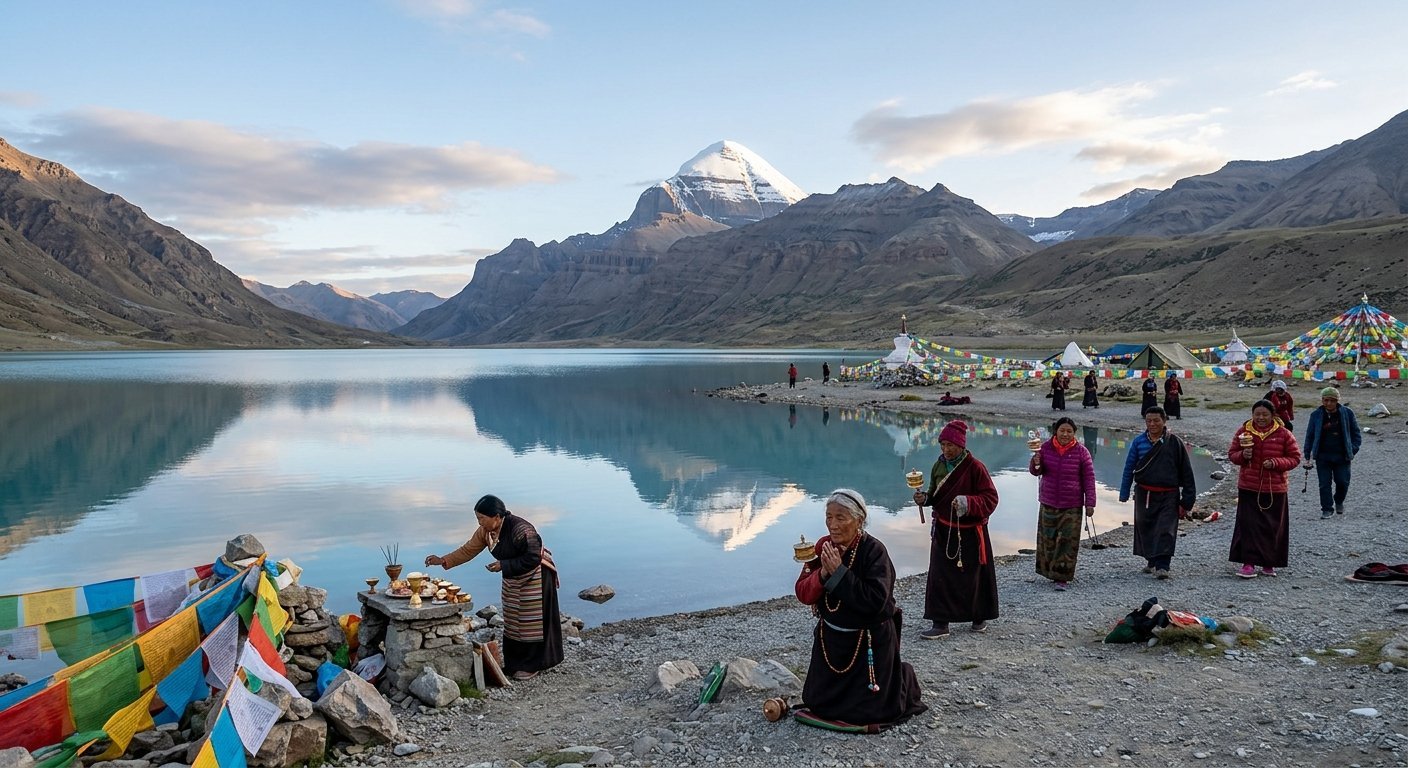
From Kathmandu, we drive to the Nepal-Tibet border and cross into Tibet. The drive to Mount Kailash takes several days with stops for acclimatization at Saga, Paryang, and Manasarovar. You’ll reach Lake Mansarovar before starting the Parikrama. That first view of the lake — still, sacred, ringed by mountains — is when most yatris realize why they came.
The Parikrama itself begins at Darchen. Day one is relatively gentle — about 20 kilometers to Dirapuk. Day two is the hardest: you cross Dolma La Pass at 18,600 feet and descend to Zutulpuk. That’s roughly 22 kilometers and it will test you. Day three is the descent back to Darchen, about 10 kilometers. Manageable if you’re conditioned.
Throughout the trek, we provide support staff, packed meals, tents, and emergency oxygen. Horses are available if you can’t walk certain sections — there’s no shame in that. Completing the Parikrama is what matters, not how you do it.
After the Parikrama, we return through the same route to Kathmandu. Total yatra duration is usually 12 to 14 days depending on the itinerary.

Common Questions NRIs From USA and Canada Actually Ask Me
Can I join the yatra if I’m traveling alone?
Yes. Many of our NRIs come solo. You’ll join a small private batch, and by day two, it won’t feel like you’re alone. Shared pilgrimage builds connection faster than any other travel I’ve seen.
What if I get altitude sickness during the Parikrama?
We carry emergency oxygen, medications, and our guides are trained in high-altitude first response. If symptoms are severe, we arrange evacuation to a lower altitude. It’s rare, but we’re prepared. That’s why acclimatization in Kathmandu and gradual ascent matters — most altitude issues are preventable.
Do I need travel insurance?
Absolutely. Get comprehensive travel insurance that covers high-altitude trekking and emergency evacuation. Most standard policies exclude above 12,000 feet. Read the fine print. We can recommend providers who specialize in this if you need guidance.
How do I balance work and the yatra preparation?
The NRI Kailash Yatra guide we provide includes a phased prep plan. You’re not training two hours a day for 12 months. You’re building cardio three to four times a week for 20 to 30 minutes initially, scaling up closer to departure. It fits around a full-time job. I’ve guided software engineers, doctors, and consultants who managed it while working 50-hour weeks.
Why We’ve Been Doing This Since 1996
Kailash Pilgrim isn’t a tour company that added Kailash packages because they’re trending. We started with this pilgrimage, and it’s still all we do. Since 1996, I’ve led yatris to Mount Kailash through political changes, permit complications, weather disasters, and everything in between. We’ve never lost a yatri. We’ve never canceled mid-journey.
Our NRI clients from the USA and Canada often tell me they chose us because we’re not selling them a trip — we’re guiding them through a sacred commitment. That difference shows up in how we communicate, how we prepare you, and how we support you on the ground.
If you’re holding a US or Canadian passport and you’ve been wondering whether the Kailash Mansarovar Yatra for NRIs is something you can actually do — not someday, but in 2026 during the Horse Year — the answer is yes. If you’re physically capable, spiritually ready, and willing to prepare properly, the path is open.
Don’t let myths about visas, fitness, or logistics stop you. The bureaucracy is manageable. The trek is hard but doable. The preparation is structured. And the experience will change you in ways I still can’t fully put into words after 20 journeys.
Ready to Begin Your Kailash Mansarovar Journey?
If you’re an NRI in the USA or Canada and the 2026 Horse Year is calling you toward Mount Kailash, let’s talk. Kailash Pilgrim has been guiding yatris like you for nearly three decades, and we’ll walk you through every step — from your first question to your final descent from Dolma La.
Visit our website or reach out directly. We’ll send you the detailed itinerary, answer your specific questions about the Mansarovar pilgrimage Canada and USA process, and start your preparation plan. The sacred journey begins the moment you decide you’re ready.
This is your year. Don’t wait for the next Horse Year in