Mount Kailash: Sacred Axis of the Universe — Hindu Cosmology and Pilgrimage Significance
You’ve probably heard Mount Kailash called the centre of the world. That’s not metaphor — in Hindu cosmology, the Mount Kailash sacred mountain is literally understood as the axis mundi, the point where heaven touches earth. Stand at its base and you’re not just at another mountain. You’re at the cosmic pivot point that holds reality together.
I’m Shalini Patel, and I’ve completed the Kailash Mansarovar Yatra more than twenty times since 1996. What strikes me every single journey isn’t the altitude or the terrain — though both will test you. It’s the palpable sense that this place operates by different rules. Pilgrims don’t just visit Kailash. They answer a calling that’s been waiting for them their entire lives.
Here’s what you need to understand: Mount Kailash isn’t sacred because someone declared it so. The mountain’s significance runs through the oldest cosmological texts, through Puranic literature, through the lived experience of millions of devotees who’ve made the parikrama. Both Buddhist and Hindu cosmology identify Mount Kailash with Mount Meru — the mythical mountain that forms the axis of the universe. That’s not a recent interpretation. That’s thousands of years of unbroken tradition.
This guide walks you through exactly what makes Kailash the axis of the universe in Hindu thought, why it matters for your spiritual journey, and how to prepare for the pilgrimage that will transform everything you thought you understood about devotion.
What Makes Mount Kailash the Axis of the Universe
The concept of axis mundi runs through almost every ancient tradition — a sacred centre where all directions converge. But Mount Kailash isn’t just a symbolic centre. In Hindu cosmology, it’s the literal pivot around which the cosmic order rotates.
Mount Kailash is universally regarded as the axis of the universe, a sacred point where the heavens and earth converge. The mountain rises from the Tibetan plateau at 6,638 metres, unclimbed and — according to both religious prohibition and government regulation — permanently off-limits to mountaineers. That’s deliberate. Some places aren’t meant to be conquered. They’re meant to command reverence.
The Hindu texts describe Mount Meru as the golden mountain at the centre of existence. Four faces. Four directions. Rivers flowing from its peak to nourish the four corners of the world. And here’s what most people miss — Kailash perfectly matches that description. Four distinct faces aligned to the cardinal directions. Four major rivers — the Indus, Sutlej, Brahmaputra, and Karnali — originating in the Kailash region. The geography mirrors the cosmology so precisely that calling it coincidence requires more faith than accepting the connection.
I’ve watched pilgrims from every tradition circle the mountain. Hindus. Buddhists. Jains. Bon practitioners. Each brings their own lens, but the axis mundi understanding stays constant. The mountain doesn’t belong to one path. It predates sectarian boundaries.
Here’s what changes when you accept Kailash as the cosmic centre: everything else becomes peripheral. Your daily concerns. Your accumulated achievements. The identities you’ve constructed. At the axis, those things don’t vanish — they just reveal themselves for what they always were. Temporary. Provisional. Not nearly as solid as you’d convinced yourself.
Mount Kailash as Shiva’s Abode — The Spiritual Geography
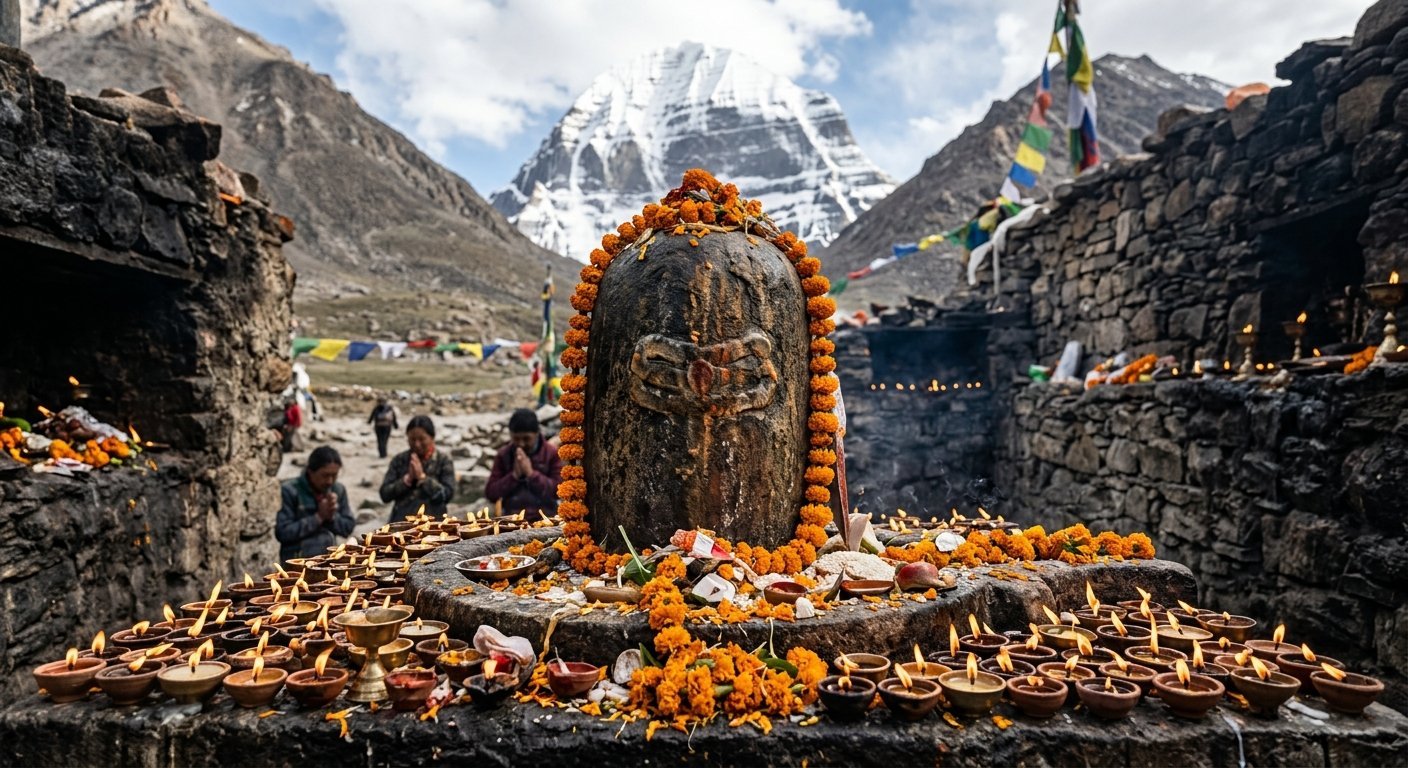
Lord Shiva sits in perpetual meditation at the summit of Kailash. That’s not legend — that’s the foundational geography of Hindu devotional practice. The mountain graces the spiritual tapestry of Hinduism as the revered dwelling place of Lord Shiva, and according to ancient Hindu beliefs, the mighty lord sits in eternal stillness at the peak.
You can’t separate Shiva from Kailash. Mahadev isn’t visiting the mountain. He is the mountain. The immovable consciousness. The unchanging awareness that witnesses the entire cosmic dance while remaining utterly still. When pilgrims approach Kailash, they’re not travelling to see where Shiva lives. They’re entering his presence.
The south face of Kailash — the face you see when you first arrive at Darchen before beginning the parikrama — is called the “gate to heaven” in Tibetan tradition. Vertical rock faces. Snow and ice forming natural lingam patterns that shift with the seasons. I’ve seen grown men weep at first sight of that face. Not from physical exhaustion — though the altitude hits hard. From recognition. Something inside them remembers.
But here’s the part most pilgrimage operators won’t tell you: the spiritual geography matters more than the physical route. You can walk the 52-kilometre parikrama path and completely miss the point. I’ve seen it happen. Tourists treating Kailash like Everest Base Camp — a box to tick, a story to tell. They walk the circuit. They take the photos. They leave exactly as they arrived.
The pilgrimage to Shiva’s abode demands something different. You don’t approach Kailash to ask for blessings — though devotees do that too. You come to surrender the self-image that’s been blocking your vision. The mountain doesn’t give you anything. It strips away what was never real to begin with.
Parvati sits beside Shiva on Kailash in the mythology. Nandi stands guard. Ganga flows from Shiva’s matted locks. These aren’t children’s stories. They’re teachings about consciousness, devotion, and the relationship between the absolute and the relative. The geography is theology. The theology is lived practice.
The Cosmic Symbolism — Why Kailash Holds the Universe Together
According to Tibetan beliefs, the mountain was the centre of the universe — not metaphorically, but structurally. Remove the axis and the whole thing collapses. That’s the cosmological claim, and it shapes how every aspect of the pilgrimage unfolds.
Think of Kailash as the spindle in a spinning wheel. The world rotates around it. The sacred Mount Meru of Hindu cosmology functions exactly this way — a golden mountain connecting the underworlds below, the earthly realm in the middle, and the celestial spheres above. Seven continents surround it. Seven oceans ring those continents. The whole mandala of existence organised around one unmoving centre.
And here’s where it gets interesting: the mountain’s symbolic structure mirrors inner spiritual architecture. The axis mundi isn’t just geographical. It’s the human spine. The central channel every yogic tradition describes. The sushumna nadi running from the base of the spine to the crown of the head. Kailash externalises what already exists inside you.
Most pilgrims don’t grasp this until they’re halfway through the parikrama. The outer journey — the physical circumambulation — gradually aligns with an inner revolution. Walking clockwise around Kailash isn’t exercise. It’s a mandala offering. Your body becomes the offering. Your ego becomes the fuel for the fire of transformation.
I’ve guided hundreds of pilgrims over two decades, and the breakthrough moment always comes at the Dolma La pass. That’s the high point — 5,630 metres — where you’re supposed to die symbolically. Leave something behind. Not your trekking pole. Not your energy bar wrapper. The story you’ve been telling yourself about who you are.
The cosmic symbolism works because it’s not abstract. The mountain gives you 52 kilometres to work it out. Physical exhaustion. Altitude sickness. Cold. Discomfort. All the protective layers you normally hide behind get burned away. What remains — if you let the process happen — is what was there before you learned to perform your identity.
Kailash holds the universe together by being immovable. Unchanging. Utterly indifferent to your opinions, your suffering, your enlightenment. That indifference is the teaching. Shiva doesn’t care if you finish the parikrama or turn back at the first teahouse. Your liberation isn’t his project. It’s yours.
The Four Faces of Kailash — Directional and Spiritual Meaning
Mount Kailash presents four distinct faces, each aligned precisely to a cardinal direction. North. South. East. West. This isn’t approximate. The symmetry is so exact that multiple traditions built entire cosmological systems around it.
The south face — the one most pilgrims see first from Darchen — represents the realm of humans. That’s your entry point. Ground level. The face you approach with all your accumulated karma, your hopes, your fears. It’s steep. Forbidding. The rock strata form horizontal bands that look almost architectural, as if the mountain was designed rather than formed by tectonic collision.
The north face opens to the realm of gods and celestial beings. You don’t see it on the standard parikrama route unless you detour or view it from a distance. The energy shifts dramatically on the northern side — ask any pilgrim who’s completed multiple circuits. It’s quieter. Less turbulent. The wind even sounds different.
The east face catches the first light. Symbolically, it represents birth, renewal, the dawn of consciousness. And the west face — where the sun sets — holds the energy of completion, dissolution, the end of cycles. Walking the parikrama, you move through all four in sequence. Birth to death to rebirth, compressed into three days of walking.
Here’s what that means practically: don’t rush the circuit. I’ve seen groups trying to complete the parikrama in a single day. Technically possible if you’re fit and acclimatised. Spiritually? You’re missing the entire architecture. Each face needs attention. Each direction carries teachings you can’t absorb at a near-run.
The symmetry extends beyond the visible faces. The rivers flowing from the Kailash region align with the four directions — the Sutlej flowing west, the Brahmaputra east, the Indus north, the Karnali south. The mountain doesn’t just point in four directions. It pours life force in four directions. Axis mundi made visible through hydrology.
At Kailash Pilgrim, we spend a full year preparing pilgrims for the Yatra specifically because directional awareness matters. Not in some mystical sense — though that’s there too. But practically. The south face hits you with full afternoon sun. The north side drops temperature by ten degrees. The east face funnels wind through narrow valleys. The west side holds afternoon storms during monsoon season. Four faces. Four weather patterns. Four completely different physical experiences on the same day.
Mount Kailash in Hindu Texts — Puranic References and Sacred Literature
The Skanda Purana calls Kailash the foremost among mountains. Not the tallest — it’s not. Not the most difficult — plenty of peaks present harder technical challenges. The foremost because it’s the dwelling place of the divine consciousness itself.
Multiple Puranic texts reference Kailash, but they’re not travel guides. They’re theology disguised as geography. The descriptions focus less on elevation and more on the spiritual coordinates — what happens to consciousness in proximity to the sacred. According to ancient Hindu beliefs recorded in the Puranas, the mighty lord sits in eternal meditation at Kailash’s summit, and the mountain’s very existence maintains cosmic order.
The Shiva Purana describes Kailash as beyond ordinary measure. Pilgrims who’ve tried to climb it report disorientation, equipment failure, overwhelming dread — not because the mountain is technically impossible, but because it refuses to be conquered. Both religious prohibition and Tibetan government policy protect Kailash from climbing attempts, but honestly, the mountain protects itself. No serious attempt has ever come close.
Here’s what the texts get right that modern descriptions miss: Kailash isn’t meant to be understood through geology or geography. It operates at the intersection of the physical and metaphysical. The mountain exists in multiple dimensions simultaneously. Your rational mind sees a peak. Your subtle awareness registers something entirely different.
The Mahabharata references Kailash as the northern anchor of sacred geography. Himalaya — the abode of snow — stretches across the subcontinent’s northern boundary, and Kailash stands as the crown jewel of that range. Not geographically — Kailash sits in the Transhimalaya, technically separate from the main Himalayan chain. But spiritually, it’s the summit that organises everything else.
I’ve read the relevant passages from the Puranas in Sanskrit and in translation, and here’s what strikes me: the descriptions sound like direct reports from people who’d actually made the journey. The Puranas describe the altitude sickness. The pristine glacial waters of Mansarovar. The sense of time distortion that happens during parikrama. These aren’t invented details. They’re field notes written in devotional language.
The Pilgrimage Circuit — Completing the Parikrama
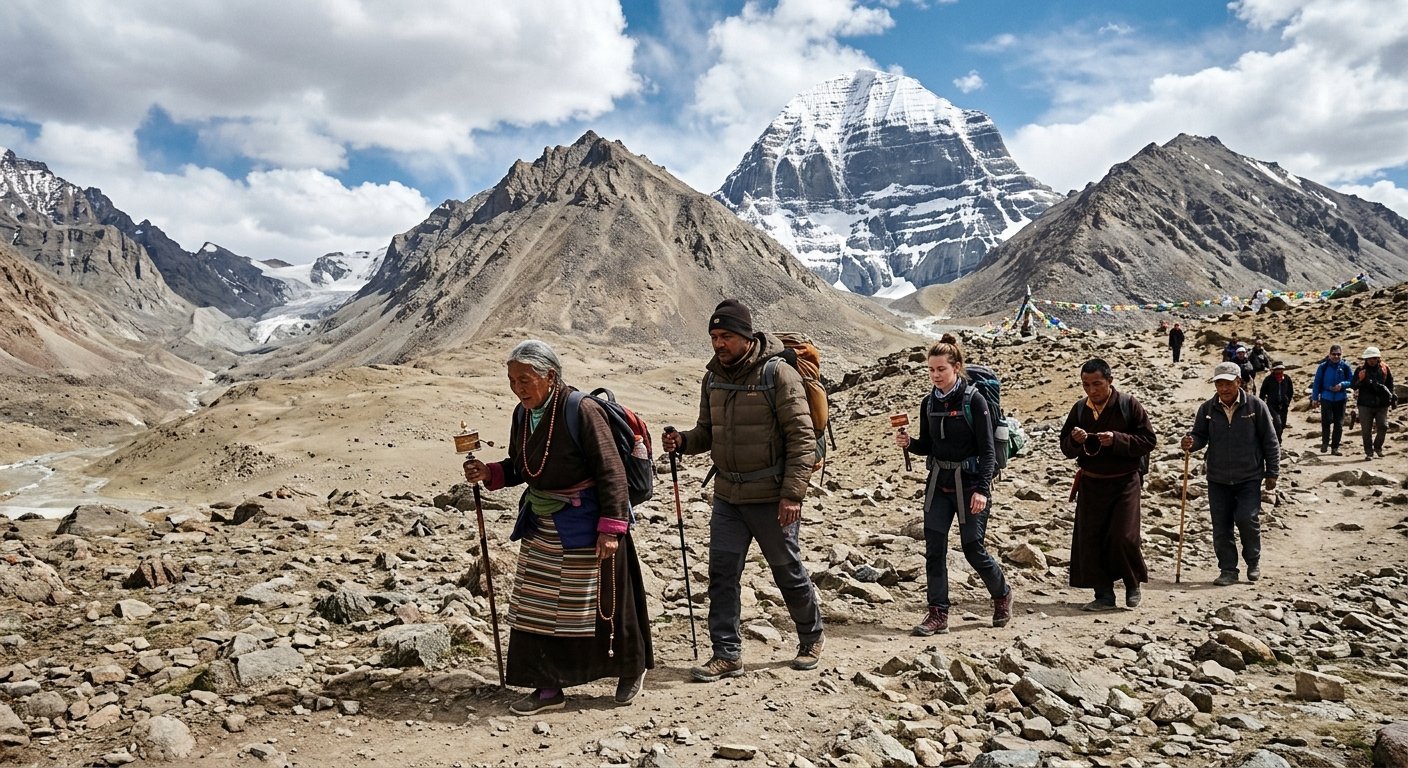
The parikrama around Mount Kailash covers 52 kilometres of high-altitude terrain. Three days for most pilgrims. Some complete it in one day. Some take five. The physical distance matters less than what happens internally during those circuits.
You start and finish at Darchen, a small settlement at 4,600 metres. Already higher than any point in the lower 48 United States. Already high enough that you’re functioning at 60% of your sea-level oxygen capacity. And that’s base camp. The route climbs from there.
Day one takes you from Darchen to Dirapuk monastery on the north side of the mountain — about 20 kilometres. Gradual ascent. Manageable if you’re acclimatised. The landscape opens up as you walk. Prayer flags snap in the wind. Pilgrims from a dozen countries moving at different paces, but everyone walking clockwise.
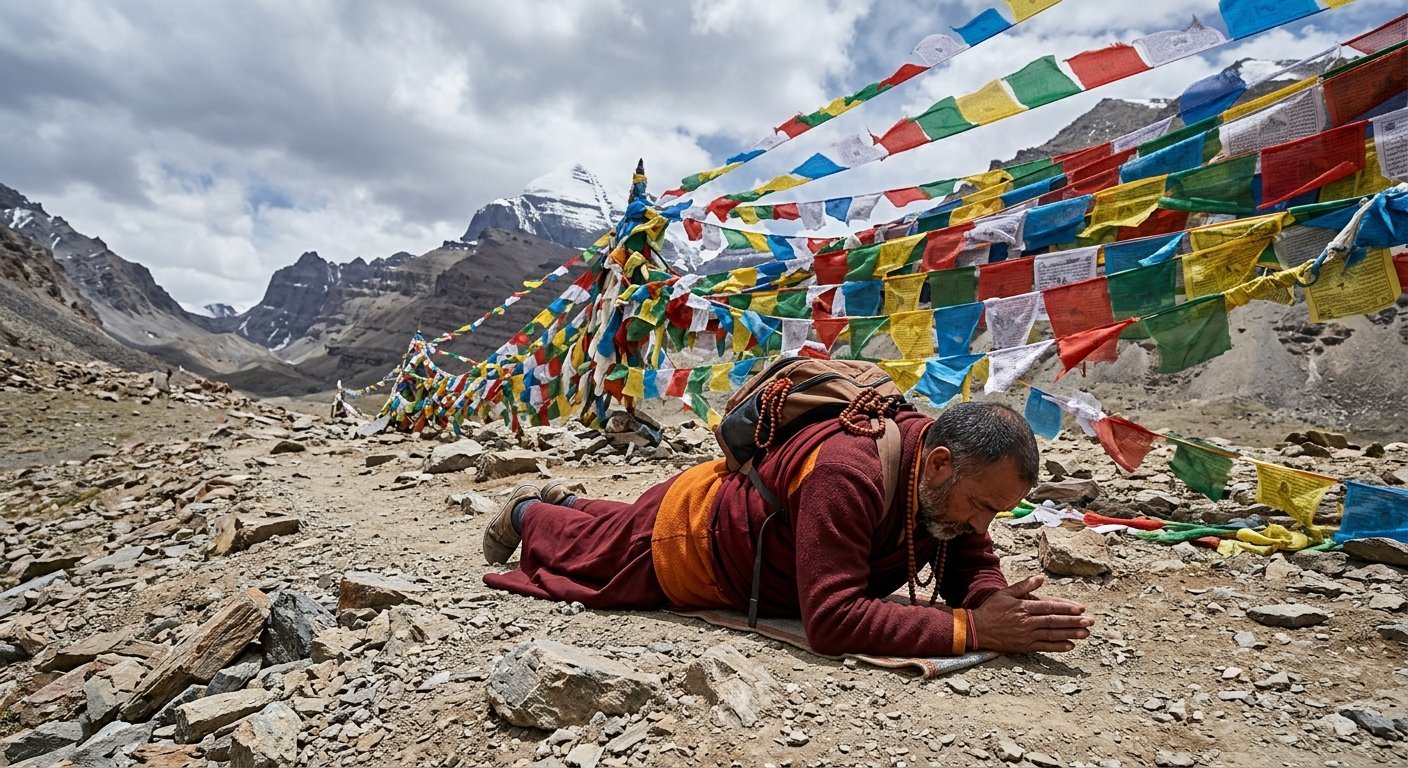
Day two is where the pilgrimage earns its reputation. Darchen to Dolma La pass — the high point at 5,630 metres — then down to Zutulpuk monastery. You’re crossing the shoulder of the mountain. The altitude hits differently above 5,000 metres. Every step requires deliberate effort. Your body’s screaming for oxygen that isn’t there.
Dolma La is where you’re supposed to die symbolically. Prostrate. Leave an offering. Release something. Most pilgrims leave a piece of clothing or a lock of hair to represent the old self being shed. Some leave photos. Some just sit and weep. The pass doesn’t force anything, but something about that specific spot — the prayer flags, the thin air, the absolute silence between gusts of wind — breaks people open.
Day three descends back to Darchen. About 16 kilometres. Your legs are destroyed. Your lungs are raw. And something inside you is utterly, completely quiet for maybe the first time in decades.
Here’s what nobody tells you about the parikrama: the physical challenge is the easy part. Fit people struggle. Elderly pilgrims with serious preparation finish without drama. I’ve watched 70-year-old devotees complete the circuit with more grace than 30-year-old athletes because the elders understood it was never about physical strength.
The parikrama strips away pretence. You can’t perform enlightenment at 5,600 metres when you’re gasping for breath. You can’t maintain your social mask when you’re squatting behind a rock because altitude’s wrecked your digestion. The mountain removes every prop. What’s left is what was always there.
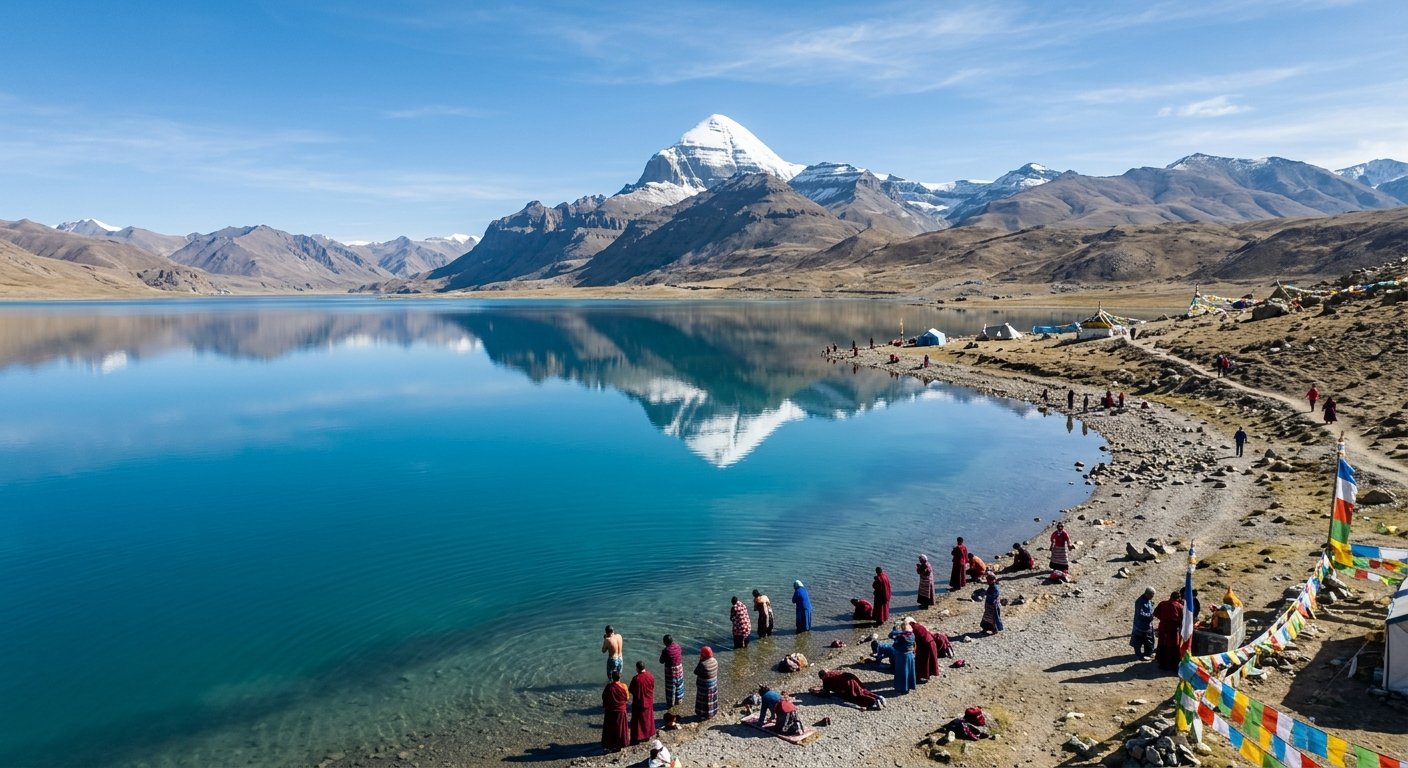
At Kailash Pilgrim, we don’t rush anyone. We provide oxygen support, medical monitoring, Sherpa assistance — all the practical infrastructure. But we also build in rest days. Acclimatisation stops. Time to sit with Mansarovar Lake. Time to let the mountain work on you before you even start walking. Because the parikrama isn’t a trek. It’s an initiation.
Why 2026 Matters — The Fire Horse Year and Rare Sacred Alignment
2026 is a Tibetan Fire Horse Year — a once-in-twelve-years occurrence that amplifies the spiritual potency of the Kailash pilgrimage. According to Tibetan Buddhist calculations, completing the parikrama during a Fire Horse Year equals 13 circuits in a normal year.
That’s not superstition. That’s centuries of observation about how consciousness responds to specific temporal alignments. The Tibetan calendar tracks subtle energetic shifts that the Gregorian calendar ignores completely. Fire Horse Years carry a particular intensity — more transformation, more breakthrough, more potential for genuine liberation.
And 2026 carries additional significance for Hindu pilgrims: it aligns with several auspicious periods in the Vedic calendar system. The spiritual convergence makes this particular year uniquely powerful for Kailash Yatra, and devotees planning the pilgrimage understand they’re not just booking a trek. They’re stepping into a rare window.
Here’s the practical implication: 2026 will see unprecedented numbers of pilgrims attempting the Kailash circuit. Permits will be harder to secure. Accommodation at Darchen, Dirapuk, and Zutulpuk will fill months in advance. If you’ve been feeling the pull toward Kailash, 2026 is the year to commit — but only if you start preparing now.
The Fire Horse Year also intersects with the Mahakumbh alignment — another rare celestial convergence that happens at longer intervals. Multiple sacred calendars lining up simultaneously. This is the kind of timing that happens once or twice in a lifetime, and devotees who understand these cycles have already begun their preparations.
At Kailash Pilgrim, we started taking 2026 bookings in early 2025. By mid-year, we were at 60% capacity. Not because we’re limiting numbers arbitrarily — though we do maintain smaller groups for safety and spiritual integrity. But because permit allocations from the Chinese authorities are finite, and 2026 demand is already breaking records.
Don’t let the sacred timing create urgency that overrides good preparation. Fire Horse Year or not, showing up at Kailash unprepared — physically, mentally, spiritually — guarantees you’ll struggle unnecessarily. The mountain doesn’t lower its standards because the calendar’s auspicious.
Physical Preparation — Training Your Body for High Altitude
Altitude acclimatisation starts months before you board the flight to Kathmandu. This isn’t optional. This is the difference between completing the parikrama and collapsing at Dolma La while a Sherpa hauls you down on horseback.
Start with cardiovascular endurance. You need to walk 15–20 kilometres comfortably at sea level before you even think about attempting Kailash. That’s baseline. Incorporate elevation gain — stairs, hills, incline treadmill. Your legs need to remember how to keep moving when they’re screaming for rest.
But here’s where most preparation advice goes wrong: you can’t truly replicate Kailash conditions unless you live at altitude. No amount of sea-level training fully prepares your body for functioning at 5,600 metres. What you can do is build the cardiovascular base and mental resilience that’ll let you adapt faster once you’re there.
We recommend six months of consistent preparation. Three times per week minimum. Walking with a loaded backpack — start with 5 kilos, work up to 10. Practice on terrain that mimics the parikrama: rocky paths, gradual ascents, uneven surfaces. Your ankles need conditioning as much as your lungs.
Strength training matters more than most pilgrims realise. Core stability. Leg strength. Shoulder endurance for carrying your daypack. You don’t need gym-level fitness, but you need functional strength. The parikrama takes three days of continuous effort. Fatigue accumulates. Weak links become obvious.
And here’s the part nobody enjoys hearing: lose excess weight before you attempt Kailash. Every extra kilo makes the altitude hit harder. Your cardiovascular system already has to work overtime compensating for thin air. Don’t make it carry unnecessary load.
At Kailash Pilgrim, we provide detailed preparation protocols to every pilgrim a full year before departure. Weekly training schedules. Altitude simulation strategies for those with access to altitude training facilities. Diet modifications to optimise oxygen transport and reduce altitude sickness risk. The pilgrims who follow the protocols consistently have a 90%+ completion rate. The ones who show up undertrained struggle, and sometimes we have to make the hard call to send them back rather than risk serious altitude complications.
Physical fitness doesn’t guarantee spiritual breakthrough, but physical collapse definitely prevents it.
Spiritual Preparation — The Inner Work Before the Outer Journey
The Mount Kailash sacred mountain demands more than physical readiness. You’re not hiking. You’re answering a call that’s been waiting for you — possibly for lifetimes.
Spiritual preparation starts with honest self-assessment. Why Kailash? If the answer is “bucket list” or “adventure travel,” you’re approaching the pilgrimage from the wrong frame. Those motivations won’t sustain you when you’re at Dolma La, oxygen-starved and questioning everything.
The real question is: what are you willing to release? The parikrama is a death ritual. Symbolic, yes, but symbolic acts have real consequences. You’ll leave something at that pass — pride, fear, a relationship that’s already dead but you’ve been clinging to, an identity that stopped serving you years ago. If you’re not ready to let something die, the pilgrimage will be geographically interesting and spiritually empty.
We guide pilgrims through a year-long spiritual preparation process at Kailash Pilgrim. Daily mantra practice — Rudram, Mahamrityunjaya, or whatever connects to your tradition. Meditation to build witness consciousness. Reading the relevant Puranic texts about Kailash. Not academic study — devotional reading that primes your awareness.
Fasting helps. Not extreme asceticism — that’ll wreck your high-altitude performance. But intermittent fasting, periodic dietary restriction, reducing dependence on comfort food. You’re training your system to function with less. That’s exactly what Kailash demands.
Connect with other pilgrims before departure. The journey’s intensely personal, but you’re not doing it alone. Shared intention amplifies the field. And honestly, you’ll need those connections when you’re struggling at altitude. Pilgrimage bonds run deeper than ordinary friendship.
Here’s what I tell every first-time Kailash pilgrim: the mountain will give you exactly what you’re ready for. Not what you want. Not what you imagine spiritual breakthrough looks like. What you’re actually ready to receive. That might be profound awakening. That might be humbling confrontation with your limitations. That might be nothing dramatic — just a quiet shift that takes months to fully recognise.
What to Expect — Realistic Challenges and Common Obstacles
Altitude sickness is not a possibility. It’s a certainty for most pilgrims. Headaches. Nausea. Sleep disruption. Shortness of breath doing absolutely nothing. Your body simply cannot function normally at 5,000+ metres. Understanding that ahead of time reduces panic when symptoms hit.
The cold surprises people. Even in summer — June through September, the standard pilgrimage season — nighttime temperatures at Darchen drop near freezing. Higher up, it’s colder. Wind chill cuts through every layer. Your extremities go numb. You’ll wear every piece of clothing you packed and still shiver.
Accommodation is basic. Very basic. Guesthouses at Darchen have beds, sometimes heat, occasionally hot water. Don’t expect it. The monastery guesthouses at Dirapuk and Zutulpuk are more rustic — shared rooms, pit toilets, no showers. You’re on Kailash’s terms now. Comfort isn’t part of the deal.
Food is repetitive. Rice. Noodles. Thin vegetable curry. Tibetan bread. Tea. For three days, variety isn’t an option. Your appetite will disappear anyway from altitude. Force yourself to eat. Your body needs fuel even when your brain’s not registering hunger.
The walking is relentless. Not technically difficult — you’re not rock climbing. Just endless. Step after step after step at altitude where your lungs are screaming and your legs are concrete. Mental endurance matters more than physical strength. The ability to keep moving when everything in you wants to stop.
Here’s the obstacle that breaks more pilgrims than physical challenge: psychological resistance. About eight hours into day one, your mind starts negotiating. “This is pointless.” “I could be home.” “This isn’t what I expected.” “I’m not having the transcendent experience I was promised.” That voice is relentless. Louder than the altitude headache. And it’s testing whether you’re serious.
At Kailash Pilgrim, we’ve seen every variation of resistance. Pilgrims who turn back after the first teahouse. Pilgrims who melt down at Dolma La. Pilgrims who finish the circuit and immediately want to start another. The mountain doesn’t care which category you fall into. Your ego cares. A lot. That’s the whole point.
We provide medical support — oxygen cylinders, altitude medication, experienced Sherpas monitoring every pilgrim. But we can’t walk for you. We can’t surrender your resistance for you. That part is non-transferable.
Practical Logistics — Permits, Routes, and Planning Your 2026 Journey
The Kailash pilgrimage requires multiple permits, none of which you can secure independently as an individual traveller. You need a registered tour operator with established Tibet connections. The Chinese authorities don’t issue Kailash permits to solo travellers. Period.
Start with the Tibet Travel Permit — the foundational document that allows entry to the Tibet Autonomous Region. Then you need the Alien’s Travel Permit for travel outside Lhasa. Then the Military Permit for the restricted zones that include Mount Kailash. Then additional permits specific to the Kailash region. The bureaucracy is deliberate. It limits numbers and ensures pilgrims travel with proper support infrastructure.
Processing time varies, but expect minimum eight weeks. For 2026 Fire Horse Year, start the permit application six months before your planned departure. Early applications stand better chance of approval, and if you’re applying for a larger group, coordination gets exponentially more complex.
The standard route enters through Kathmandu, overland to Kerung border crossing, then north across the Tibetan plateau to Darchen. That’s 4–5 days of travel before you even start the parikrama. The journey itself is acclimatisation — gradual altitude gain that gives your body time to adjust.
Alternative routes include flying to Lhasa and driving west to Kailash. Longer. More expensive. Better acclimatisation profile. Or helicopter packages that reduce ground travel time dramatically — best for pilgrims with time constraints or physical limitations that make long overland journeys impractical.
For 2026 specifically, we’re recommending the Kathmandu route through Kailash Pilgrim because road infrastructure has improved significantly, the acclimatisation profile is safer, and border processing is more predictable than air routes that depend on weather and variable flight schedules.
Cost varies by route, group size, and support level. Budget US$3,000–5,000 for standard overland package. Double that for helicopter options. Those figures include permits, transport, accommodation, meals, guide and Sherpa support, oxygen equipment, and medical backup. They don’t include international flights, visa fees, insurance, or personal equipment.
Book early for 2026. We’re not exaggerating demand. Fire Horse Year combined with post-pandemic pilgrimage backlog means unprecedented numbers attempting Kailash. Late bookings will either face inflated prices or get shut out completely when permit quotas fill.
The Return — Integration and Life After Kailash
Completing the parikrama isn’t the end. It’s the beginning of something else entirely. What you experience at Kailash doesn’t stay at Kailash — it follows you home and quietly dismantles every structure you thought was permanent.
The first two weeks after returning are strange. You’re physically exhausted. Emotionally raw. And suddenly back in a world that doesn’t recognise what just happened to you. Your family sees you walked around a mountain. They don’t see that something fundamental shifted.
Integration takes time. Months, usually. Sometimes years. The insights that seemed blazingly obvious at Dolma La get fuzzy when you’re back in traffic, back at work, back in the routine that runs on autopilot. That’s normal. The mountain’s teaching doesn’t depend on you remembering every moment. It rewires you below conscious awareness.
Expect relationships to shift. Some friendships won’t make sense anymore. Conversations that used to engage you feel hollow. That’s not judgment — that’s changed frequency. You’re not better than anyone. You’re just operating from different reference points, and the gap shows.
Some pilgrims rush back into normal life and try to forget Kailash happened. Cognitive dissonance becomes overwhelming — how do I hold the person I was at the pass and the person paying the mortgage? The answer: you don’t. The integration happens by letting both versions exist simultaneously until they’re not separate anymore.
Others make dramatic changes — quit jobs, end marriages, move countries. Sometimes that’s genuine response to clarity. Sometimes it’s ego panic trying to force breakthrough rather than allow it. Be careful of major life decisions in the first six months after Kailash. The mountain’s work continues. Let it finish before you start burning structures down.
At Kailash Pilgrim, we offer post-pilgrimage integration support — not formal therapy, but connection to other returned pilgrims, guidance from those who’ve been through the process multiple times, and realistic frameworks for metabolising what happened. You’re not alone in this. Thousands of pilgrims have walked this specific path of return and reintegration.
The mountain gave you something. Your job now is to live it — not perform it, not explain it, not turn it into content. Just let it change you quietly, thoroughly, permanently.
Frequently Asked Questions
Can anyone complete the Mount Kailash sacred mountain parikrama or do you need special fitness?
You don’t need athlete-level fitness, but you absolutely need consistent physical preparation and good cardiovascular health. Pilgrims in their 60s and 70s complete the circuit regularly — they succeed because they prepare properly for a full year before departure. The mountain demands endurance more than strength, and altitude makes everything harder. Start training six months out minimum: walking 15–20 kilometres with elevation gain, building stamina, and strengthening your core and legs. Medical clearance is required, and those with serious heart, lung, or altitude-related health issues shouldn’t attempt the pilgrimage.
Why is Mount Kailash called the axis mundi in Hindu cosmology?
Mount Kailash is identified with Mount Meru, the mythical cosmic mountain that forms the literal axis of the universe in Hindu cosmological texts. Both Buddhist and Hindu traditions describe it as the pivot point where heaven and earth meet, and where Lord Shiva sits in eternal meditation. The mountain’s four faces align perfectly with cardinal directions, and four major rivers flow from the Kailash region, mirroring the Puranic descriptions of Mount Meru. The mountain isn’t symbolically the centre — according to Hindu cosmology, it structurally holds the universe together as the unmoving axis around which all creation rotates.
What makes the 2026 Fire Horse Year significant for Kailash pilgrimage?
2026 is a Tibetan Fire Horse Year — a cycle that occurs once every twelve years and is considered especially auspicious for Kailash pilgrimage. According to Tibetan Buddhist calculations, completing one parikrama during a Fire Horse Year carries the spiritual merit of thirteen circuits in a normal year. The year also aligns with several favourable periods in the Vedic calendar system, creating rare convergence. Demand for 2026 permits is already unprecedented, so pilgrims feeling the call should begin preparation and booking immediately, as permit quotas will fill much earlier than typical years.
How long does the Kailash Mansarovar Yatra take from start to finish?
The complete Yatra takes approximately 12–14 days from Kathmandu and back. That includes 4–5 days of overland travel to reach Darchen (the starting point for parikrama), 3 days for the 52-kilometre circuit around Mount Kailash, time at Lake Mansarovar for ritual bathing and prayers, and return journey. Helicopter packages reduce ground travel time significantly but still require minimum 8–10 days for proper acclimatisation and completion of the pilgrimage circuit. We always recommend adding buffer days for altitude acclimatisation and weather delays — rushing the timeline drastically increases altitude sickness risk and reduces spiritual depth of the experience.